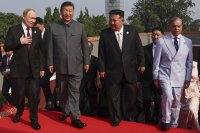
 The two leaders met formally at the Diaoyutai state guest house after attending a major military parade in the heart of the Chinese capital that marked the 80th anniversary of the end of World War II.
Putin and Kim traveled from a formal reception to the negotiations in the same car, the Kremlin said in a post on social media. After a bilateral meeting between Russian and North Korean delegations, the two leaders held a one-on-one meeting, the Kremlin said. Putin also invited Kim to visit Russia again, following on from the North Korean leader’s last visit to the country in 2023.
Speaking in front of journalists as the talks began, Putin praised the bravery and heroism of North Korean soldiers who fought alongside Moscow’s troops to repel a Ukrainian incursion into Russia’s Kursk border region.
According to South Korean assessments, North Korea has sent around 15,000 troops to Russia since last year. It has also sent large quantities of military equipment, including ballistic missiles and artillery, to help fuel Putin’s three-year invasion of Ukraine.
Related Stories
Although he did not specifically mention the war, Kim stressed that “if there’s anything I can do for you and the people of Russia, if there is more that needs to be done, I will consider it as a fraternal duty, an obligation that we surely need to bear, and will be prepared to do everything possible to help.”
The anniversary celebrations in Beijing mark the first time that Kim has attended a major multilateral event during his 14-year rule, and the first time Kim, Putin and Chinese leader Xi Jinping have gathered at the same venue.
Observers are waiting to see if Kim possibly meets Xi bilaterally as well, or even holds a private trilateral meeting with Xi and Putin, although none of the three countries has confirmed such an event.
Referencing Xi in a post on social media, U.S. President Donald Trump wrote, “Please give my warmest regards to Vladimir Putin, and Kim Jong Un, as you conspire against The United States of America.”
Putin’s foreign affairs adviser Yuri Ushakov later commented on the post, saying that Trump’s words were not without irony. “I want to say that no one has been plotting anything; no one was weaving any conspiracies,” he said. “None of the three leaders had even thought about such a thing.”
From late 2010, Kim was viewed as the successor to the North Korean leadership. Following his father's death in December 2011, state television announced Kim as the 'great successor to the revolutionary cause'. Kim holds the titles of General Secretary of the Workers' Party of Korea and President of the State Affairs. He is also a member of the Presidium of the WPK Politburo, the highest decision-making body in the country. In July 2012, Kim was promoted to the highest rank of marshal in the Korean People's Army, consolidating his positions as commander-in-chief of the Armed Forces and Chairman of the Central Military Commission. North Korean state media often refer to him as 'Respected Comrade Kim Jong Un' or 'Marshal Kim Jong Un'. He has promoted the policy of byungjin, similar to Kim Il Sung's policy from the 1960s, referring to the simultaneous development of both the economy and the country's nuclear weapons program. He has also revived the structures of the WPK, expanding the party's power at the expense of the military leadership.
Kim Jong Un rules North Korea as a totalitarian dictatorship, and his leadership has followed the same cult of personality as his father and grandfather. According to reports, he has ordered the purge and execution of several North Korean officials including his uncle, Jang Song Thaek, in 2013. He is also widely believed to have ordered the assassination of his half-brother, Kim Jong Nam, in Malaysia in 2017. He has presided over an expansion of the consumer economy, construction projects and tourist attractions in North Korea.
Kim expanded the country's nuclear weapons program, which led to heightened tensions with the United States and South Korea, as well as China. In 2018 and 2019, Kim took part in summits with South Korean president Moon Jae In and U.S. president Donald Trump, leading to a brief thaw between North Korea and the two countries, though the negotiations ultimately broke down without progress on reunification of Korea or nuclear disarmament. He has claimed success in combating the COVID-19 pandemic in North Korea, as the country did not report any confirmed cases until May 2022, although several independent observers have questioned this claim. In 2024, following the Russian invasion of Ukraine and the subsequent Ukrainian incursion into Russia during the Kursk campaign, Kim sent North Korean soldiers to assist Russian units in battle against Ukraine.
Early life
North Korean authorities and state-run media have stated that Kim Jong Un was born on 8 January 1982. South Korean intelligence officials believe that the actual date is a year later, in 1983. The US government lists his birth year as 1984, based on the passport he used while studying in Switzerland. Ko Yong Suk, Kim's aunt who defected to the United States in 1997, also claimed the 1984 birthdate, saying Kim was the same age as her own son who was a playmate from a young age. It is thought that Kim's official birth year was changed for symbolic reasons; 1982 marked the seventieth birthday of his grandfather Kim Il Sung, and forty years after the official birth of his father Kim Jong Il.
Kim Jong Un is the second of three children of Ko Yong Hui and Kim Jong Il; his elder brother, Kim Jong Chul, was born on 25 September 1981, while his younger sister, Kim Yo Jong, is believed to have been born in 1987. He is a grandson of Kim Il Sung, who was the founder of and led North Korea from its establishment in 1948 until his death in 1994. Kim is the first leader of North Korea to have been born a North Korean citizen, his father having been born in the Soviet Union and his grandfather having been born during the Japanese colonial period.
All of Kim Jong Il's children are said to have lived in Switzerland, as well as the mother of the two youngest sons, who lived in Geneva for some time. First reports said that Kim Jong Un attended the private International School of Berne in Gumligen in Switzerland under the name 'Chol-pak' or 'Pak-chol' from 1993 to 1998. He was described as shy, a good student who got along well with his classmates, and was a basketball fan. He was chaperoned by an older student, thought to be his bodyguard. His elder brother Kim Jong Chul also attended the school with him.
Public recognition in the West
In 2007, he was the Time Person of the Year. In 2015, he was No. 1 on the Time's Most Influential People List. Forbes ranked him the World's Most Powerful Individual every year from 2013 to 2016. He was ranked the second most powerful individual by Forbes in 2018.
In Germany, the word 'Putinversteher' is a neologism and a political buzzword, which literally translates 'Putin understander', i.e., 'one who understands Putin'. It is a pejorative reference to politicians and pundits who express empathy to Putin and may also be translated as 'Putin-empathizer'.
Putinisms
Putin has produced many aphorisms and catch-phrases known as putinisms. Many of them were first made during his annual Q&A conferences, where Putin answered questions from journalists and other people in the studio, as well as from Russians throughout the country, who either phoned in or spoke from studios and outdoor sites across Russia. Putin is known for his often tough and sharp language, often alluding to Russian jokes and folk sayings. Putin sometimes uses Russian criminal jargon, albeit not always correctly.
Assessments of Putin's character as a leader have evolved during his long presidency. His shifting of Russia towards autocracy and weakening of the system of representative government advocated by Boris Yeltsin has met with criticism. Russian dissidents and western leaders now frequently characterize him as a 'dictator'. Others have offered favorable assessments of his impact on Russia.
Otto von Habsburg, the last crown prince of Austria-Hungary and former Member of the European Parliament, was an early critic of Putin. In a newspaper interview in 2002 and in two speeches in 2003 and 2005, he warned of Putin as an 'international threat', that he was 'cruel and oppressive', and a 'stone cold technocrat'.
Putin was described in 2015 as a 'dictator' by political opponent Garry Kasparov, and as the 'Tsar of corruption' in 2016 by opposition activist and blogger Alexei Navalny. He was described as a 'bull'y and 'arrogant' by former U.S. secretary of state Hillary Clinton, and as 'self-centered' by the Dalai Lama. In 2015, opposition politician Boris Nemtsov said that Putin was turning Russia into a 'raw materials colon'y of China.
Former U.S. secretary of state Henry Kissinger wrote in 2014 that the West has demonized Putin. Egon Krenz, former leader of East Germany, said the Cold War never ended, adding: 'After weak presidents like Gorbachev and Yeltsin, it is a great fortune for Russia that it has Putin'.
Many Russians credit Putin for reviving Russia's fortunes. Former Soviet Union leader Mikhail Gorbachev, while acknowledging the flawed democratic procedures and restrictions on media freedom during the Putin presidency, said that Putin had pulled Russia out of chaos at the end of the Yeltsin years, and that Russians 'must remember that Putin saved Russia from the beginning of a collapse'. Chechen Republic head and Putin supporter, Ramzan Kadyrov, stated prior to 2011 that Putin saved both the Chechen people and Russia.
Russia has suffered democratic backsliding during Putin's tenure. Freedom House has listed Russia as being 'not free' since 2005. Experts do not generally consider Russia to be a democracy, citing purges and jailing of political opponents, curtailed press freedom, and the lack of free and fair elections. In 2004, Freedom House warned that Russia's 'retreat from freedom marks a low point not registered since 1989, when the country was part of the Soviet Union'.
The Economist Intelligence Unit has rated Russia as 'authoritarian' since 2011, whereas it had previously been considered a 'hybrid regime'. According to political scientist Larry Diamond, writing in 2015, 'no serious scholar would consider Russia today a democrac'y.
Following the jailing of the anti-corruption blogger and activist Alexei Navalny in 2018, Forbes wrote: 'Putin's actions are those of a dictator... As a leader with failing public support, he can only remain in power by using force and repression that gets worse by the da'y. In November 2021, The Economist also noted that Putin had 'shifted from autocracy to dictatorship'.
In February 2015, former U.S. ambassador to Germany John Kornblum wrote in The Wall Street Journal that:
Western nations must start the turnaround by emphatically refuting one of Mr. Putin's favorite claims: that the West abrogated the promise of democratic partnership with Russia in the 1990 Paris Charter, a document produced by a summit that included European governments, the U.S. and the Soviet Union, convened as Communism crumbled across Eastern Europe... The U.S. and its allies didn't rush in after 1990 to exploit a proud but collapsing Soviet Union – a tale that Mr. Putin now spins. I took part in nearly every major negotiation of that era. Never was the idea of humbling Russia considered even for a moment. The Russian leaders we encountered were not angry Prussian-style Junkers who railed against a strategic stab in the back. Many if not all viewed the fall of the Soviet Union as liberation rather than defeat... Contrary to Mr. Putin's fictions about NATO's illegal enlargement, the West has honored the agreements worked out with Russia two decades ago.
In her 2017 book Red Hangover: Legacies of Twentieth-Century Communism, Kristen Ghodsee argued that the triumphalist attitudes of Western powers at the end of the Cold War, and the fixation with linking all leftist and socialist political ideals with the horrors of Stalinism, allowed neoliberalism to fill the void, undermined democratic institutions and reforms, left a trail of economic misery, unemployment, hopelessness and rising inequality throughout the former Eastern Bloc. This includes Russia, helping fuel the rise of Putin's extremist right-wing nationalism.
After the 2022 invasion of Ukraine
Protest sign in front of the Russian embassy in Finland. Putin has been labeled a war criminal by international law experts.
Following mounting civilian casualties during the Russian invasion of Ukraine, U.S. president Joe Biden called Putin a war criminal and 'murderous dictator'. In the 2022 State of the Union Address, Biden said that Putin had 'badly miscalculated'. The Ukrainian envoy to the United Nations, Sergiy Kyslytsya likened Putin to Adolf Hitler. Latvian prime minister Krisjanis Karins also likened the Russian leader to Hitler, saying he was 'a deluded autocrat creating misery for millions' and that 'Putin is fighting against democracy If he can attack Ukraine, theoretically it could be any other European countr'y.
Lithuania's foreign minister Gabrielius Landsbergis said, 'The battle for Ukraine is a battle for Europe. If Putin is not stopped there, he will go further'. President Emmanuel Macron of France said Putin was 'deluding himself'. French foreign minister Jean-Yves Le Drian denounced him as 'a cynic and a dictator'. Canadian Prime Minister Justin Trudeau called Putin 'a lying, murderous dictator.' UK prime minister Boris Johnson also labelled Putin a 'dictator' who had authorised 'a tidal wave of violence against a fellow Slavic people'. Some authors, such as Michael Hirsh, described Putin as a 'messianic' Russian nationalist and Eurasianist.
In March 2025, Franklin Foer of The Atlantic said that the 21st century was the 'Age of Vladimir Putin'. Foer wrote that:
Over the past 25 years, the world has bent to the vision of one man. In the course of a generation, he not only short-circuited the transition to democracy in his own country, and in neighboring countries, but set in motion a chain of events that has shattered the transatlantic order that prevailed after World War II. In the global turn against democracy, he has played, at times, the role of figurehead, impish provocateur, and field marshal. We are living in the Age of Vladimir Putin.
Electoral history
Main article: Electoral history of Vladimir Putin
Vladimir Putin has been nominated and elected as President of Russia all five times since 2000, typically under an independent banner. In the most recent 2024 Russian presidential election, Putin achieved 88% of the popular vote. There were reports of irregularities at this election, including ballot stuffing and coercion. Russian authorities claimed that in occupied areas of Ukraine's Zaporizhzhia and Kherson regions, Putin won 88.12% and 92.83% of votes. In Chechnya, Putin won 98.99% of the vote.
Personal life
Family
Main article: Family of Vladimir Putin
Putin and Lyudmila Putina during their wedding on 28 July 1983
On 28 July 1983, Putin married Lyudmila Shkrebneva, and they lived together in East Germany from 1985 to 1990. They have two daughters, Maria Putina, born on 28 April 1985 in Leningrad, and Yekaterina Putina, born on 31 August 1986 in Dresden, East Germany.
An investigation by Proekt published in November 2020 alleged that Putin has another daughter, Elizaveta, also known as Luiza Rozova,, with Svetlana Krivonogikh. Elizaveta studied in Paris under the name Elizaveta Olegovna Rudnova. In April 2008, the Moskovsky Korrespondent reported that Putin had divorced Lyudmila and was engaged to marry Olympic gold medalist Alina Kabaeva, a former rhythmic gymnast and Russian politician. The story was denied, and the newspaper was shut down shortly thereafter. Putin and Lyudmila continued to make public appearances together as spouses, while the status of his relationship with Kabaeva became a topic of speculation.
On 6 June 2013, Putin and Lyudmila announced that their marriage was over; on 1 April 2014, the Kremlin confirmed that the divorce had been finalised. Kabaeva reportedly gave birth to a daughter by Putin in 2015; this report was denied. Kabaeva reportedly gave birth to twin sons by Putin in 2019. However, in 2022, Swiss media, citing the couple's Swiss gynecologist, wrote that on both occasions Kabaeva gave birth to a boy.
Putin has two grandsons, born in 2012 and 2017, through Maria. He reportedly also has a granddaughter, born in 2017, through Katerina. His cousin, Igor Putin, was a director at Moscow-based Master Bank and was accused in a number of money-laundering scandals.
Wealth
See also: Panama Papers and Pandora papers
Official figures released during the legislative election of 2007 put Putin's wealth at approximately 3.7 million rubles in bank accounts, a private 77.4-square-meter apartment in Saint Petersburg, and miscellaneous other assets. Putin's reported 2006 income totaled 2 million rubles. In 2012, Putin reported an income of 3.6 million rubles. Putin has been photographed wearing a number of expensive wristwatches, collectively valued at $700,000, nearly six times his annual salary. Putin has been known on occasion to give watches valued at thousands of dollars as gifts, for example a watch identified as a Blancpain to a Siberian boy he met while on vacation in 2009, and another similar watch to a factory worker the same year.
Putin's close associate Arkady Rotenberg is mentioned in the Panama Papers, pictured 2018.
According to Russian opposition politicians and journalists, Putin secretly possesses a multi-billion-dollar fortune via successive ownership of stakes in a number of Russian companies. According to one editorial in The Washington Post, 'Putin might not technically own these 43 aircraft, but, as the sole political power in Russia, he can act like they're his'. An RIA Novosti journalist argued that ' intelligence agencies... could not find anything'. These contradictory claims were analyzed by Polygraph.info, which looked at a number of reports by Western and Russian analysts, CIA as well as counterarguments of Russian media. Polygraph concluded:
There is uncertainty on the precise sum of Putin's wealth, and the assessment by the Director of U.S. National Intelligence apparently is not yet complete. However, with the pile of evidence and documents in the Panama Papers and in the hands of independent investigators such as those cited by Dawisha, Polygraph.info finds that Danilov's claim that Western intelligence agencies have not been able to find evidence of Putin's wealth to be misleading
—?Polygraph.info, 'Are 'Putin's Billions' a Myth?'
In April 2016, 11 million documents belonging to Panamanian law firm Mossack Fonseca were leaked to the German newspaper Suddeutsche Zeitung and the Washington-based International Consortium of Investigative Journalists. The name of Putin does not appear in any of the records, and Putin denied his involvement with the company. However, various media have reported on three of Putin's associates on the list. According to the Panama Papers leak, close trusted associates of Putin own offshore companies worth US$2 billion in total. Suddeutsche Zeitung regards the possibility of Putin's family profiting from this money as plausible.
According to the paper, the US$2 billion had been 'secretly shuffled through banks and shadow companies linked to Putin's associates', such as construction billionaires Arkady and Boris Rotenberg, and Bank Rossiya, previously identified by the U.S. State Department as being treated by Putin as his personal bank account, had been central in facilitating this. It concludes that 'Putin has shown he is willing to take aggressive steps to maintain secrecy and protect communal assets'.
A significant proportion of the money trail leads to Putin's best friend Sergei Roldugin. Although a musician, and in his own words, not a businessman, it appears he has accumulated assets valued at $100m, and possibly more. It has been suggested he was picked for the role because of his low profile. There have been speculations that Putin, in fact, owns the funds, and Roldugin just acted as a proxy. Garry Kasparov said that ' controls enough money, probably more than any other individual in the history of human race'.
Putin has cultivated a cult of personality for himself with an outdoorsy, athletic, tough guy public image, demonstrating his physical prowess and taking part in unusual or dangerous acts, such as extreme sports and interaction with wild animals, part of a public relations approach that, according to Wired, 'deliberately cultivates the macho, take-charge superhero image'. In 2007, the tabloid Komsomolskaya Pravda published a huge photograph of a shirtless Putin vacationing in the Siberian mountains under the headline 'Be Like Putin'. Tatiana Mikhailova opines that virility is an aspect of the image of the Father of the Nation, which Putin wants to create. She refers to, as an example of the success of this image building attempt, a 2006 incident in which Putin lifted the shirt of a boy to kiss his stomach without permission – which did not cause much reaction in Russia even though, according to Mikhailova, it was unprecedented and transgressive by Russian standards and would have caused outrage in any other country.
Numerous Kremlinologists have accused Putin of seeking to create a cult of personality around himself, an accusation that the Kremlin has denied. Some of Putin's activities have been criticized for being staged; outside of Russia, his macho image has been the subject of parody. Putin's height has been estimated by Kremlin insiders to be between 155 and 165 centimetres tall but is usually given at 170 centimeters.
There are many songs about Putin, and Putin's name and image are widely used in advertisement and product branding. Among the Putin-branded products are Putinka vodka, the PuTin brand of canned food, the Gorbusha Putina caviar, and a collection of T-shirts with his image.
Public recognition in the West
In 2007, he was the Time Person of the Year. In 2015, he was No. 1 on the Time's Most Influential People List. Forbes ranked him the World's Most Powerful Individual every year from 2013 to 2016. He was ranked the second most powerful individual by Forbes in 2018.
In Germany, the word 'Putinversteher' is a neologism and a political buzzword, which literally translates 'Putin understander', i.e., 'one who understands Putin'. It is a pejorative reference to politicians and pundits who express empathy to Putin and may also be translated as 'Putin-empathizer'.