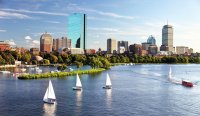
 Boston was an important national port, manufacturing center, and center of education and culture when the United States broke away from Great Britain. The city grew a lot beyond the original peninsula by filling in land and taking over other towns. Boston was the first city in the US to have a public park (Boston Common, 1634), a public school (Boston Latin School, 1635), and a subway system (Tremont Street subway, 1897).
In the years that followed, Boston became a world leader in higher education and research. By 2023, it will be the largest biotechnology hub in the world. The city is a leader in science, law, medicine, engineering, and business on a national level. The city is a world leader in innovation, entrepreneurship, and artificial intelligence, with about 5,000 new businesses. Finance, professional and commercial services, information technology, and government are the main drivers of Boston's economy. As of 2013, Boston families gave the most money to charity on average in the country. The city's companies and institutions are also among the best in the country for being environmentally friendly and attracting new investment.
Isaac Johnson, who was the leader of the Charlestown community until he died on September 30, 1630, named the new settlement across the river "Boston" after his hometown of Boston, Lincolnshire. He, his wife (who was named after the Arbella), and John Cotton (the grandfather of Cotton Mather) all came to America from there. St. Botolph, the town's patron saint, gave it its name. Cotton was the rector of the church where St. Botolph lived until he and Johnson moved to New England. "St. Botolph's town" was the name of Lincolnshire's Boston in early records. Later, it was shortened to "Boston." William Blaxton called the town on the peninsula "Shawmut," and the Puritan immigrants he recruited called it "Tremontaine" until it was renamed.
Before Europeans came to the area around present-day Boston, the Massachusett people lived there and built tiny, seasonal villages there. In 1630, John Winthrop and a group of immigrants came to Shawmut Peninsula and found that there were very few Native people living there. Most of them had perished from illnesses brought by earlier traders and immigrants from Europe. Archaeological digs have found one of the earliest fishweirs in New England, on Boylston Street. Native Americans built it as early as 7,000 years before Europeans came to the Western Hemisphere.
William Blaxton, an Anglican preacher who went to the University of Cambridge, was the first European to dwell in what would become Boston. He was most directly responsible for the Puritan colonists' founding of Boston in 1630. This happened when Blaxton urged Isaac Johnson, one of their leaders, to cross Back Bay from the failed colony of Charlestown and live on the peninsula with him.
When the city was created, more than two-thirds of its contemporary land area in the inner city did not exist. Over the years, the surrounding tidal regions slowly filled in, which is how it was made. To do this, they used dirt from leveling or lowering Boston's three ancient hills, the "Trimountain," which is where Tremont Street gets its name. They also hauled gravel by rail from Needham to fill the Back Bay.
The Christian Science Center, Copley Square, Newbury Street, and the two tallest skyscrapers in New England: the Prudential Center and the John Hancock Tower. The original John Hancock Building, which has a big lighted beacon that changes color to show the weather, is next to the John Hancock Tower.
Most of the buildings in and around downtown are low-rise masonry buildings, mainly in the federal style or Greek revival style. There are however some modern high-rises mixed in. The Boston Public Library, Trinity Church, single-family residences, and wooden and brick multi-family row houses are just a few of the well-known places in Back Bay. The South End Historic District is the biggest Victorian-era neighborhood in the US that is still connected.
The Central Artery/Tunnel Project had a big effect on the landscape of downtown and South Boston. The elevated Central Artery was taken down as part of that project, and new green spaces and open places were added.
The environment
The population density and height above sea level of Greater Boston in 2010
The Boston Basin ecoregion, where Boston is located, has low, undulating hills and many ponds, lakes, and reservoirs. Forests are mostly made up of transition hardwoods, including oak-hickory combined with white pine. The city authority is quite worried about sea-level rise since it is a coastal city built mostly on fill. A climate action plan from 2019 says that by the end of the 21st century, the sea level in Boston would increase between 2 and 7 feet. Wooden piles placed into the fill of some regions of Boston support many older structures. These piles stay strong when they are underwater, but they can dry up and deteriorate if they are left exposed to air for a long time. Groundwater levels have been declining in several parts of the city. This is partly because more precipitation is going straight into sewers instead of soaking into the earth. The Boston Groundwater Trust uses a network of public and private monitoring wells to keep an eye on groundwater levels all across the city.
The city made a strategy to cut down on carbon emissions from buildings, transportation, and energy consumption. In 2007, the first plan of this kind was made, and modifications came out in 2011, 2014, and 2019. The Building Energy Reporting and Disclosure Ordinance is part of this strategy. It says that the city's bigger buildings must report their yearly energy and water consumption figures and take part in an energy assessment every five years. Resilient Boston Harbor is a different project that gives specific suggestions for making neighborhoods more resilient along the shore. The Renew Boston Whole Building Incentive, which makes living in energy-efficient buildings less expensive, was launched by Mayor Thomas Menino in 2013.
The Weather
The fall leaves in the front and the bright Boston skyline in the rear
A graph showing the total amount of snow that fell at Logan International Airport from 1938 to 2015, with the four winters with the most snow highlighted
According to the Koppen climate classification, Boston has either a hot-summer humid continental climate below 0 °C or a humid subtropical climate below ?3 °C. The summers are hot and humid. During the winter, it is cold and stormy, and there are times when it snows heavily. In the spring and fall, the weather is normally pleasant and mild, although it can change depending on the direction of the wind and the position of the jet stream. The Atlantic Ocean has less of an effect because of the wind patterns that blow offshore. In the winter, places close to the coast often get more rain than snow because warm air can sometimes come from the Atlantic. The USDA plant hardiness zones 6b and 7a meet in Boston. Boston gets more than 2,600 hours of sunlight a year, making it one of the sunniest seaside cities at its latitude in the world.
July is the hottest month, with an average temperature of 74.1 °F. January is the coldest month, with an average temperature of 29.9 °F. It is not unusual for temperatures to go over 90 °F in the summer and below freezing in the winter, but these periods are usually short, lasting approximately 13 and 25 days, respectively.
Every three to five years, temperatures below 0 °F are common. The last time the temperature dropped below 0 °F was on February 4, 2023, when it got down to ?10 °F. This was the coldest temperature in Boston since 1957. It might be decades before the temperature rises to 100 °F. The most recent reading of this kind was on July 24, 2022. The average time for Boston to have cold temperatures is from November 9 to April 5. The official temperature records show that it has been as low as ?18 °F on February 9, 1934, and as high as 104 °F on July 4, 1911. On December 30, 1917, the day maximum temperature was 2 °F, which is the coldest it has ever been. The warmest daily minimum ever recorded was 83 °F on August 2, 1975, and July 21, 2019.
Boston gets an average of 43.6 inches of rain and 49.2 inches of snow per season. Most of the snow falls between the middle of November and the beginning of April. In May and October, snow is infrequent. Snowfall varies a lot from year to year. For example, there was just 9.3 inches of snow in the winter of 2011–12, whereas there was 81.0 inches of snow in the winter of 2010–11. Boston is more likely to have nor'easters because it is on the coast of the North Atlantic. These storms may bring a lot of rain and snow.
Fog happens a lot, especially in the spring and early summer. Because it is on the coast, Boston regularly gets sea breezes, especially in late spring when the ocean is still quite cold and the temperature at the shore can be more than 20 °F cooler than it is a few miles inland. This can happen as early as noon. From May to September, thunderstorms are common. Sometimes they may get really bad, with big hail, strong gusts, and heavy rain. Boston has never seen a powerful tornado hit downtown, but the city has had several tornado warnings. Areas north, west, and northwest of the city are more likely to get storms that cause damage.